
Coming in cold? Head on over to Part One to get the whole sordid story.
We’ll be here when you catch up.
17 November 1934. 10:03 PM. Stonegate, Forge City.
A pair of yellow headlights turned the corner of Parkhurst and Van Fleet. Callaghan watched from the library’s bow window, a glass of Lagavulin in his hand. The headlights prowled closer to the house, slowed down, almost stopped.
“Turn, damn it,” Callaghan whispered.
The knot in Callaghan’s stomach unclenched just a little as the lights turned into the driveway. A sleek maroon Chrysler Imperial materialized under the light of the single streetlamp at the end of the driveway. It glided to a stop in the darkness by the garage, just out of view of the window. Callaghan swallowed the last of the whisky in his glass and set off to meet Limerick Doyle and the garbage men he’d promised.
In the garage, Callaghan passed between his Nash Ambassador and Ivy’s Chevy Master and opened the exterior door. Cold November air curled around his legs, brushed his cheeks still warm from the liquor. The Imperial’s engine stopped and the driver’s door opened. A driver in a black wool overcoat climbed out, unfurling himself to well over six feet in height. Callaghan nodded at him, but the driver offered no acknowledgement in return.
Instead, he opened the rear passenger door, and a man in a gray fedora, gray wool overcoat climbed out of the back seat and straightened. His eyes flicked across the Georgian Revival house then back to Callaghan. Kieran Limerick Doyle. There was an aura of quiet authority in bearing, his steady walk, the firm grip of his hand around Callaghan’s.
“Doctor Callaghan,” Kieran Doyle said quietly. “I’m told there was a tragedy here. My deepest condolences.”
Callaghan was only half listening. His eyes gazed past Doyle and the driver, searching the driveway and the street beyond for another car, but there was nothing. His stomach twisted and he ignored the sick feeling building in his gut. Maybe the garbage men were lagging behind.
“Something the matter, Doctor?” Doyle asked.
“Just you?” Callaghan asked. “I was expecting…”
Doyle’s brown eyes questioned Callaghan then softened into a sympathetic smile. He glanced at the driver who gave barely a flicker of a smile, then patted Callaghan on the shoulder, like the easy reassurance of an older brother.
“Let’s get out of this cold, Thomas, and you can show us the terrible thing that happened here.”
Callaghan stifled a frustrated sigh and led them through the garage into the house, only distantly aware of his own body. He led the way through the house to the library then into his private study. He stopped beside the Chesterfield but didn’t look at it.
Doyle took in the shape under the gray blanket on the Chesterfield then lifted his eyes to the bookcase, the portraits on the wall, Callaghan’s walnut desk, and the liquor cabinet. They stopped on the bottle of Lagavulin. He crossed the room, picked up the nearly empty bottle and sniffed it.
“How much of this have you had?” he asked.
Callaghan shrugged. “Does it matter?”
Doyle’s gaze didn’t falter.
“Three. Four. Eight? I lost count.”
Doyle nodded slowly, corked the bottle. To his driver he said, “Duncan, go make some coffee for our friend here.”
The driver left the study without a glance at Callaghan who shuffled in place, his cheeks warming to the humiliation of being treated like a guest in his own home. Doyle returned the bottle to the empty spot on the shelf.
“No more tonight,” he said.
Doyle crossed the room to the Chesterfield, lifted a corner of the blanket, and stared down at Clark. He recovered Clark’s face without so much as a blink. He turned to the side table between the club chairs, looked down at the crystal tumblers.
“You were celebrating something,” Doyle said. “Which one was his?”
“That one. On the right.”
Doyle picked it up, sniffed it. He sniffed it again, harder, then held the glass to the light.
“You gave him a Mickey?”
Callaghan nodded. “I needed him quiet so that…” His throat was so dry. “…so that I could complete the procedure.”
“Made it yourself?”
“Yes.”
“No residue. No odour.” Doyle’s lips twitched into an impressed smile. “My men could learn a thing or two from you.”
“Secret recipe.”
Doyle glanced at him sharply. Callaghan shrugged.
Doyle lowered himself into one of the club chairs, eyes on the blanket draped over the body on the Chesterfield.
“Tell me what happened,” he said.
Callaghan drew a shaky breath and recounted what happened.
“He turned up a little late. I could tell he was nervous, on guard, so I gave him a drink to put him at ease. We started talking. He wanted to get right down to business, but I stalled a bit to try to talk him out of the extortion. Appealed to his sense of civic duty.”
Callaghan pulled out his leather desk chair, gripped the back until his fingers dimpled the leather, but he didn’t sit. He shook his head but didn’t wake up.
“As a doctor, you learn how to read people because patients aren’t always forthcoming about the things they do that affect their health. I saw in his eyes that he wouldn’t be sweet talked out of anything.”
“That’s when he died. Tragically.”
Callaghan suppressed a shudder. “When are the trashmen coming?” he asked.
Doyle regarded him silently and Callaghan felt things sliding further out of his control. He persisted.
“You said you had men who could take care of this,” he said. “I assumed they were coming, too.”
Doyle held Callaghan’s expectant gaze until Callaghan looked away first. Doyle got to his feet.
“What I’ve learned over the years that I’ve been at this,” he said, “is that discretion is best, especially at this hour and among polite folk like these. I have men who can make a man disappear, but they would stand here out like clowns at a funeral.”
Callaghan closed his eyes. He gripped the back of his desk chair even harder.
“Then what’s going to happen with—”
The cogs spinning in Callaghan’s mind snapped to the answer.
“No,” he said. “No, no, no. I am not disposing of this body myself. You said you would take care of this.”
“And I will, but we need to proceed with caution. Who else knows about this unfortunate turn of events, Doctor?”
Callaghan fumed. “Clark’s wife,” he said. “She must have known he was going out.”
“Did she know if he was coming here?”
“I don’t know.”
“We have to be careful with her. She’s about to lose the man she loves, and she’ll start asking questions we don’t want her asking. We need to think about how we’re going to deal with her because she’s a problem we need to get ahead of. Who else?”
Ivy. At that moment, she was dumping Clark’s car at Burgess’s wrecking yard. Callaghan’s plan had been to ask Doyle to have his men dismantle it, effectively dissolving the car into parts inventory. Doyle would want to know who drove the car there and how much did they know. If he told Doyle the truth, that Ivy had come home early and witnessed the body, her name would go right under Judith’s on Doyle’s list.
Doyle stepped closer. “Who else?”
“No one.”
“Not that lovely wife of yours?”
Callaghan gritted his teeth and said, “Leave her alone. She doesn’t know anything about this.”
“Why don’t I believe you?”
A wave of heat surged through Callaghan. His jaw ached and he forced calm into his voice. “She was not here,” he said.
Doyle’s gaze sharpened. “You kept this blackmail from her?”
“Yes. I didn’t want her to worry.”
It wasn’t a lie. Ivy had done the math herself and drawn her own conclusions. That may still have been too much.
“We had planned a little weekend together,” Callaghan said, stretching the lie. “Some shows downtown, a few nights at the Sebastian. I would have joined her except for this business.” Callaghan frowned at Clark’s body. “She went off on her own. I’m joining her after we settle this.”
Doyle regarded Callaghan steadily. He felt himself being weighed and measured.
Duncan returned with a steaming mug and handed it to Callaghan.
“Drink that,” Doyle said. “You have a little work ahead of you tonight before you can see your wife.”
Callaghan took the cup from the driver, the sides scalding his fingers. He set it on the side table between the club chairs and turned on Doyle.
“You and I need to get something straight,” he said. “I don’t work for you. We’re partners. Remember? You said you have the logistics handled. This is a logistical matter.”
Doyle’s body went eerily still, like a panther studying its next meal. He pointed at the body under the blanket.
“This is murder,” he said, his voice tight with restrained menace. “Take it from an old pro, Doctor, now is not the time to call attention to yourself. Right now, it looks like you’re receiving a guest, not deliberating how to make a dead man disappear.”
Callaghan regretted ever agreeing to meet with Kieran Doyle. He was caught in a trap of his own making and Doyle was pushing him deeper into its jaws.
Doyle turned to his driver. “Take Clark out to the garage. We’ll be there in a minute.”
Duncan knelt down in front of the Chesterfield, scooped Clark up in his arms, blanket and all, and stood up as if Clark were a nothing more than a toddler he was putting to bed. Doyle picked up the mug and handed it to Callaghan.
“You need to calm down, Doctor,” he said, speaking low and steady. “What you’re feeling right now, the confusion, the fear, the guilt, it’s natural after an event like this. You’re a doctor. I’m sure you’ve lost patients before. It’s tragic. It’s the same thing here. Clark had a heart attack, and you couldn’t save him.”
Callaghan listened as Doyle casually philosophized about murder, but his mind refused to reconcile fighting to save a patient with facilitating someone’s unnatural death.
“It may not feel like it now, but you did the right thing,” Doyle said. “When I was coming up, there were rivals who tried to take away what I was building in Liffey Bend. They didn’t share my vision. They wanted it for themselves. I could have laid down and let them take it, but I did what was necessary to protect myself. I did it alone, until I had people around me I could trust.”
“You’re saying I can trust you?”
“I’m saying that in partnerships, sometimes you lead and sometimes you follow. Right now, if you want out of this, you need to follow my lead.”
There was a fleeting moment when Callaghan felt like what he’d done had guaranteed that he and Ivy were protected from harm, but things were getting complicated, more susceptible to catastrophic disruption. But it was too late to go back. All he could do was move forward and try not to complicate things further.
Callaghan lifted the mug to his lips and drank. The coffee was bitter, but he accepted it. Most things would taste bitter from now on.
In the garage, Callaghan unlocked the Chevy Master and Duncan laid Clark out on the back seat then covered him with a gray blanket. Doyle wrote in a small black notebook then tore out the page. It was an address in The Foundry.
“Go here,” Doyle said. “Ask for Teller. He knows you’re coming. He’ll make sure Clark disappears.”
“What do I tell him?” Callaghan asked.
“Just tell him you have the package I asked him to take off your hands.”
“What then? Clark has to disappear.”
“Teller’s got his instructions. You’ve got yours. When you’ve made the delivery, you turn around and come home. Be with your wife. Most important, win the election com January. We’ve got a lot of work to do.”
There it was again. That feeling he let himself be played. What had he expected would happen? He had wanted Doyle’s money, but had he really expected to stay clean? He certainly hadn’t expected to get this dirty. Anger and frustration crackled inside him like static seeking an outlet. There was a way out, but he needed time to think. Get through this, he told himself. Clark has to disappear. That’s step one. Work on a new plan when you’re clear. Callaghan folded the note and slipped it into his pocket.
He led Doyle and Duncan to the driveway exit, opened the door. Cold November air poured in, carrying a swirl of fat, white snowflakes on its tide. Duncan brushed past him and started the Imperial. Doyle donned his fedora and rested his hand on Callaghan’s shoulder, gave it a reassuring squeeze.
“Almost over,” he said. “Do your part, and my team will take care of the rest.”
He extended his hand and Callaghan shook it mechanically. There was sympathy in Doyle’s brown eyes, and something else, too. Watchfulness.
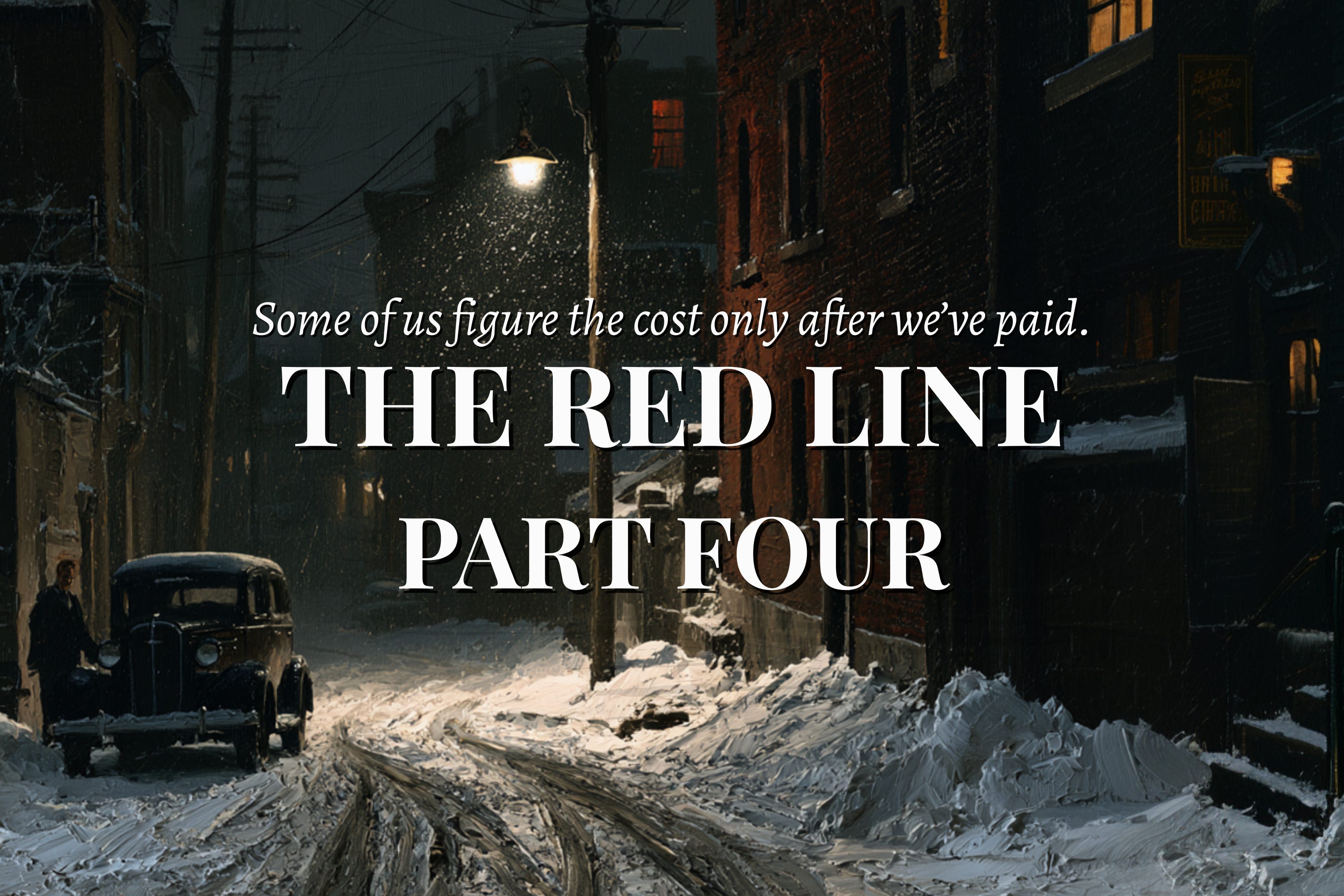
Doyle walked through the veil of falling snow, climbed into the back of the Imperial, and Callaghan watched it back out of the driveway. It rolled silently down the street, the red taillights shrinking to pinpoints that disappeared in the falling snow.
“Whatever it takes,” Callaghan whispered.
It was past 11:30 PM by the time Callaghan found the address Doyle had given him. He shut off the Chevy’s engine and sat in the cab, looking around as the engine ticked.
The Foundry was one of the oldest neighbourhoods in Forge. Narrow, twisting streets with gnarled trees, barren of leaves, growing out of the heaved sidewalk. Apartments piled haphazardly on top of shops like toy blocks left behind by a careless infant. The street bent left and right like a broken straw, and he couldn’t see the end. He climbed out and searched for a street number, but the darkened doorways kept their secrets while the shadow of the old Cruikshank refinery loomed in the distance.
He found the address on the third tour of the neighbourhood. It was a narrow, darkened doorway on the side of a hardware storefront next to an alley, secured behind an iron gate, that led to a garage behind the row of buildings. The dwelling numbers had long ago fallen off the door, and all that was left was a faint outline left in the grime. There was no buzzer, no bell cord. There wasn’t even a knob, just a recessed handle covered by a patch of white snow.
Callaghan returned to the Chevy and checked up and down the street one last time. No traffic. No pedestrians. He was alone, but he didn’t trust the feeling. The upstairs apartment windows glowed behind drawn curtains while the ground floor shops all along the street were dark, save a coffee shop down the block that sold sandwiches to the eleven-to-seven factory workers.
Callaghan tested the Chevy’s doors. All locked. Still, he hated leaving it behind. It was new and stood out in this older neighbourhood, and things that stood out made bold people curious. It wouldn’t take much to break in and discover Clark on the back seat, and then how long before the police would swarm the neighbourhood. Callaghan drew a deep breath. There was nothing he could do about it.
He returned to the alley, opened the side door and entered. The door banged shut behind him and he was alone in almost total darkness. The still air carried the damp funk of mould. He raised his foot, found the step, and started climbing . The only sound was his own breathing and the scrape of his overshoes on the wooden steps.
At the landing, a narrow window allowed meager light from the alley, and Callaghan made out the name on the door. Teller. He rapped twice, hard. Somewhere beyond the door, a radio was playing a brassy tune, but Callaghan couldn’t place it. Silence, a violent cough, followed by the shuffling of feet that drew closer until someone threw open the bolts and opened the door.
Light poured out, momentarily silhouetting a short, stocky figure. As Callaghan’s eyes adjusted, he saw the man was dressed only in a stained white undershirt and blue boxers. The gray hair on the man’s round was displeased at having been woken up. Through bleary eyes, behind a film of alcohol, the man peered up at Callaghan. They regarded each other silently until the man took the cigarette from his mouth and said, “Mayor Callaghan.”
“Just ‘alderman’, I’m afraid,” Callaghan said. “’Mayor’ if the people want me.”
“The people. As if they have any say in the matter.”
Teller stepped aside and Callaghan entered just far enough to let the door shut behind him. The apartment was small and stank of tobacco and male loneliness. It was populated by mismatched furniture.
Teller put the cigarette back in his mouth and the coal glowed hot.
“Where’s the package?” he asked.
“Downstairs. In the back of my car. I’d rather like to get him off the street.”
“It.”
“Excuse me?”
“You said ‘him’. It ain’t a person no more. You saw to that.” Teller eyed Callaghan more closely. “Thought you were a doctor. You ought to know this stuff.”
Teller turned his hairy back and crossed the apartment toward the open bedroom door. An unmade bed with a chipped white iron frame was shoved into the far corner. Teller picked some clothes off the floor and started to dress.
Someone moved under rumpled sheets and a dark head emerged. Tousled brown hair spilled across a woman’s bare shoulder. She pushed herself up into a sitting position and a pale breast appeared from beneath the curtain of brown curls. Callaghan turned his gaze to the ceiling, the kitchen, the living room, but she was lovely in a rough sort of way, and he couldn’t help but steal a glance. She yawned, rubbed her eyes, and pushed the wild hair out of her face. Her gaze met Callaghan’s and she made no move to cover herself.
“Baby, you didn’t say we were going to have company,” she said, smirking at Callaghan. He turned his back on her and felt his embarrassment rise in his cheeks. He heard the door shut.
“Who is he?” she asked. “He looks familiar.”
Callaghan groaned inwardly and checked the Cartier on his wrist.
“He’s nobody, Shirl,” Teller said. “Just a guy I have to meet.”
“He can come play.”
“No.”
“Aw. No fun.”
“I gotta work tonight. I told you.”
“Come back to bed. Send him away and keep me warm.”
Silence descended throughout the apartment, broken only by muffled, wet kisses, soft moans. Callaghan rubbed his face and checked his watch again.
“Shirl, baby, I gotta go.”
“Fine. You ain’t gonna stiff me again, are you?”
“Jesus Christ. Here. That enough? More? Fine. Take it all. Now drop it about me stiffing you, all right? It was one time. I don’t want to hear about it again.”
Callaghan heard the door open and shut. He turned around. Teller was dressed in a wrinkled blue shirt and black trousers. He was sliding suspenders over his shoulders one at a time.
“Dames,” he said, shrugging into a coat. Callaghan nodded. Seemingly there was at least one thing they had in common.
“Let’s go,” Teller said, buttoning his coat up to the neck. He led the way out of the apartment and down the stairs.
Outside, Callaghan took in deep breaths to clean the bitter smell from his nose.
“Where’s your car?” Teller asked, his cigarette wagging off his bottom lip.
Callaghan jerked his head toward the street. Teller squinted at the Chevy through a cloud of smoke as he dug through his coat pocket.
“Chevy Master. Ain’t bad. That radiator spring a leak yet?”
“No.”
“It will. Bring it by when it does. Give you a good deal on a repair.”
Teller’s hand emerged with a set of keys and he lifted a heavy padlock on a heavy chain keeping the iron gate closed.
“Go get the car and drive it around back,” Teller said. He dropped the padlock into his coat pocket and walked the gate open.
Callaghan started the Chevy and pulled into the narrow alley. Teller was already ahead of him. He followed the man to a field of clean snow that fronted a dark, three-bay garage. Teller’s Mechanical & Transmission was painted in flaking white paint above the doors.
Teller trudged through the ankle-deep snow to a small door next to the left-most bay. A moment later the corrugated steel door began rolling up. The bay was empty and Callaghan let off the brake, guiding the Chevy into the bay. He stopped at Teller’s signal, killed the engine, and climbed out.
The bay was gloomy and cluttered with machinery. A sharp tang of gasoline and cleaning solvent hung in the air.
“He’s in the rear,” Callaghan said.
Teller was unlocking the back door of a delivery van. Rothwell Meats in red over a white background and a painting of a butcher block covered in different cuts of beef, pork, and chicken. He opened the doors wide then lit another cigarette.
“Put it in here,” Teller said.
“I beg your pardon.”
“You deaf? I said, put it in here.” He jerked a thumb at the van.
Callaghan’s jaw began to ache again. He took a deep breath and stood his ground. Teller exhaled a cloud of smoke, picked something off his tongue with his thumb and middle finger, spat lightly.
“Oh!” he said, laughing. “You want me to drag that poor son of a bitch out of your car.”
“Wouldn’t mind it,” Callaghan said through a tight jaw.
Teller shook his head, mock pain on his face. “Bad back. Can’t help you. But you’ll be all right. Lift with your legs and all that.”
Callaghan heaved a sigh and glared openly at Teller.
“Just get over here and help me so we can both be on our way,” Callaghan said.
Teller’s eyes darkened. His cheeks tightened and his mouth flattened into a grimace. He started across the concrete floor, eyes fixed on Callaghan like a wolf tracking an elk. He stopped close enough that Callaghan could smell Teller’s last meal on his breath.
“You got a mark on you, Alderman,” he said. “Cain’s mark. Same as I’ve seen on dozens of men just like you. They thought they could just roll into my garage, drop their troubles off like it was laundry, and go back to normal. There’s no going back. And you need me, so you better be polite.”
Teller flicked his cigarette across the bay with contempt. It bounced on the concrete floor and burst into a shower of sparks.
Callaghan’s stomach churned. His mind flashed through a dozen years into the future, and he saw all his great accomplishments, and yet the shadow of what he’d done ran through it all. He closed his eyes, pinched the bridge of his nose. Just get through tonight, he told himself. Get out of here and back to Ivy.
Teller was still there when he opened his eyes, a malignant sneer on his face. He nodded, licked his thick lips.
“Yeah, you get it now,” he said, an unsettling glee in his eyes. “You’re just like the rest of us. Just another beast.”
Callaghan jerked back. He opened his mouth to snap back, but managed just a stammer and shut his mouth, humiliated that Teller was right.
Teller yanked open the Chevy’s rear door, reached inside, and hauled Clark out by his ankles. The body flopped onto the ground, the head bouncing off the door sill and the rough concrete.
“Be careful!” Callaghan snapped.
Teller stared at him, dumbfounded. “Why? I ain’t hurting him any more than you have.”
Callaghan’s hand fluttered to a shooting pain in his temple and rubbed it in circles as Teller dragged Clark across the concrete toward the Rothwell Meats van. He lifted Clark by the shoulders, wrapped his arms across Clark’s chest, then pushed with his legs and stood up. He shuffled toward the door, then hurled Clark inside as if he were nothing more than a sack of cement. His legs dangled off the back of the truck. Teller climbed inside the van and it shifted on its springs under his weight. He grunted once and Clark’s legs disappeared.
Callaghan thought he would feel relief, but instead he felt uneasy. No one would tell him what was going to happen to Clark. He could never come back. Ever. Incineration was best for that, and Doyle surely had access to a few through his control of the independent garbage haulers in Liffey Bend.
But he hadn’t said that’s what would happen. Maybe Callaghan should have handled all this himself, so he’d be sure it never came back.
The van shifted again and Teller climbed out. He slammed the van doors shut then crossed the floor and picked up the gray blanket dangling half outside the Chevy’s rear door. He balled it up and tossed it at Callaghan. It bounced off his chest, and he jumped back as if Teller had hurled a bucket of mud at him. Teller threw his head back and laughed until he choked.
“That’s some funny shit, Alderman!” he said, wiping his eyes.
Callaghan picked up the blanket, threw it into a trash bin.
“All right, you’re free to go on back home,” Teller said. “Have a shower. Drink some scotch. Fuck that pretty wife of yours. Get tonight out of your system.”
Teller hung a new cigarette off his lip and lit it.
“Enjoy yourself tonight,” he said. “You got a long road ahead of you.”
Callaghan climbed into the Chevy without another word to Teller. He backed out, cranked the wheel, then dropped the car into gear and stomped on the gas pedal. The rear wheels spat snow and frozen gravel, sliding sideways until they bit and the Chevy shot toward the alley. He slowed just enough not to roll as he turned onto the street.
Doyle had been concerned about outside people discovering the murder, but by Callaghan’s count there were now three potential loose ends within his own organization. Three people Callaghan couldn’t trust to keep their mouths shut.
He scanned for street signs and wondered how far he’d have to go if push came to shove.
He’d already killed one man. Did he have it in him to do it again?
“Whatever it takes,” he said to himself.
Kevin Coleman writes crime fiction from the cold edges of Canada. His characters always get what they want. That's the problem.
Our dear Dr. Callaghan is in way over his head, and he knows it.
But he’s a man with a plan, so make sure you subscribe
so you don’t miss the rest of the story.
© 2026 Kevin M. Coleman
Disclaimer
This article is an original work by Kevin M. Coleman. All rights are reserved. No part of this article may be copied, stored, or reproduced in any form — including but not limited to use in training artificial intelligence or machine learning systems — without the author’s express written permission.
Damn, this is good. Doyle now owns Callaghan. I'm sticking around to see how this ends.