
Milk Crate Confession
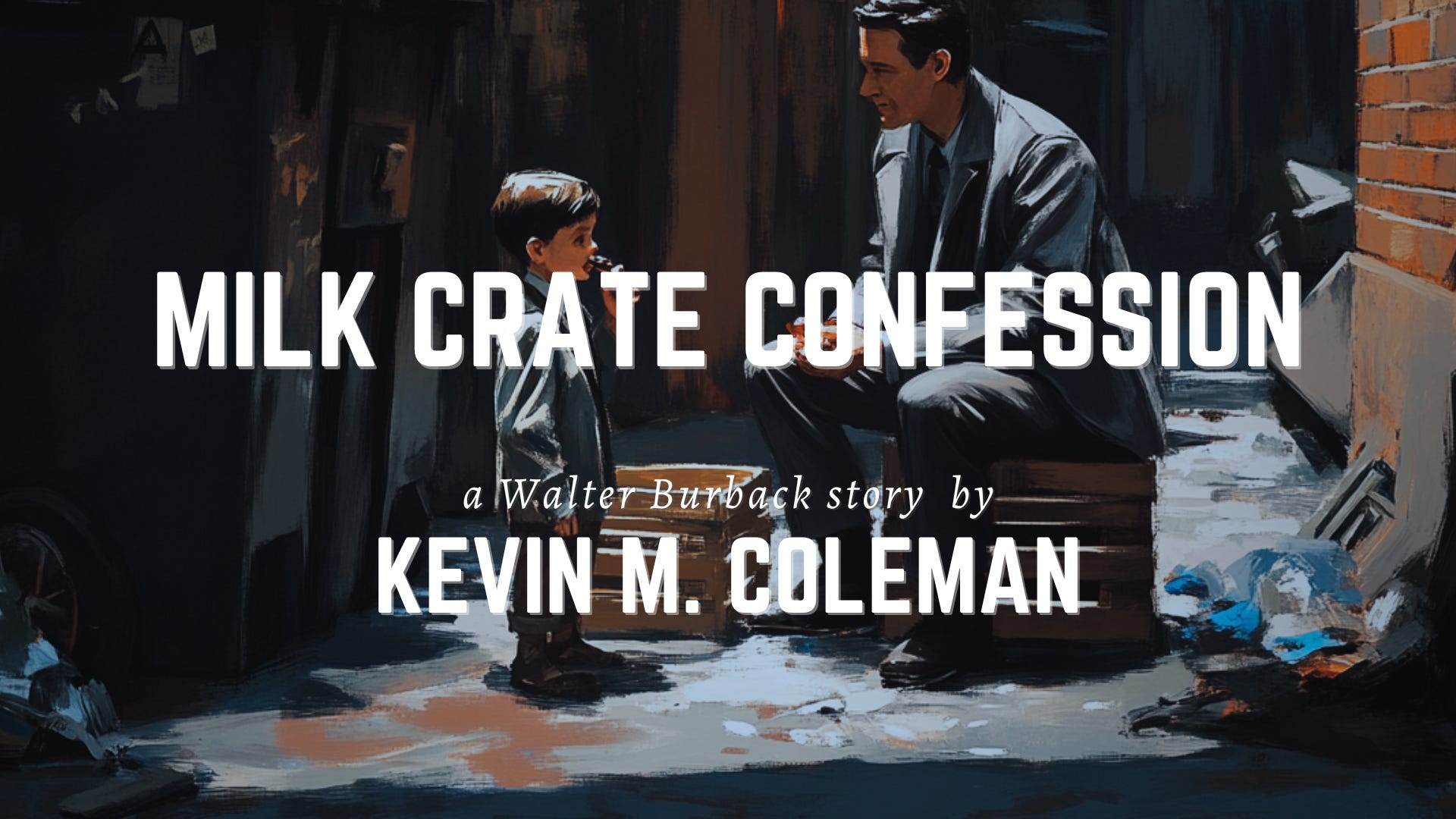
The kid asked if Walter was a bad guy. He didn't like the answer.
A Note to the Reader
A few weeks ago, I anticipated that Part Eight of The Judas Plot would be scheduled and I would be thanking you for all your support over the last month and a half. Today, only one of those things is true.
I want to thank all of you for subscribing and leaving such great comments on my work. I appreciate every subscription, every comment, and every minute you spend with my words. It means the world to me.
The bad news. Part Eight isn’t ready. I’m not satisfied with where it is yet, so instead of putting something to press just to meet a deadline, I’m postponing the finale by a week so I can keep working on it.
The good news. Just because you can’t have the finale yet doesn’t mean I’m going to leave you twisting in the wind with nothing to read. I’m pushing something up the schedule to replace Part Eight, something that you’ll really enjoy.
Forge City Noir is still a rookie pickpocket mastering its first lift, but it’s growing faster than I thought it would, and that’s because of you. The only way I know how to keep that momentum is to keep publishing stories I’m proud to put my name on.
Cheers, and enjoy the story.
Kev
The trouble started for me an hour before at Kowalski’s Pawn & Trade.
I was unloading goods I’d taken from an old widow’s Liberty Heights estate: diamond starburst brooches, Patek Philippe gold watches, silver bracelets and combs, and a silver letter opener shaped like a swan. Trash with taste.
I was in the middle of a tense negotiation with Stan Kowalski, one of my regular fences, when the cops poured in through the front door, guns drawn and barking orders. The old Pole’s shop was one of The Caesar’s money drops, and Kowalski opened fire with the Winchester trench gun he kept under the counter like he was reliving the Battle of Warsaw. Forge cops don’t take kindly to lip or lead, and the whole place broke apart into curses, terror, and bitter gun smoke.
The boys in blue wouldn’t buy the excuse that I was “just browsing”, so I got low and scurried past the counter into the shop’s storeroom, a maze of wooden shelving crammed to the ceiling with junk and illuminated by a few bare lightbulbs. Kowalski covered my retreat and slammed the steel door shut behind him.
“This way!” he hissed, leading me to the far back corner by the alley door.
Something heavy slammed into the alley door and it shivered in the frame.
“Open up, Kowalski!”
I recognized that muffled voice. Inspector Cray. Why couldn’t it have been a straight shooter, like Garrett?
We were safe for the moment from the cops in the storefront, their rifle butts hammering the heavy latch, but we were trapped in the back with the cavalry about to bust through the only exit.
Kowalski swore under his breath. He dragged me by the arm toward the back corner where an old railway trunk slept under three lumpy canvas bags. I reached for one to shift it off, but Kowalski shoved me toward the battered desk next to it.
“Don’t touch that!” he said. “That’s The Caesar’s cash. He’d geld you like a thoroughbred if you messed with it.”
Cray’s battering ram slammed into the back door again. Dust billowed from the frame.
“In there.” He pointed at the shadows living in the knee well.
“There’s no room for both of us,” I said.
Kowalski ignored me and shoved me inside. At the last second, before the alley door caved in, he dragged a box of old clothes in front of the opening.
“Stay here.”
The alley door gave way with a screech of tearing iron, and heavy boots pounded the wooden floor. Through the gap between the top of the box and the desktop, I watched Kowalski hold the trigger down and work the pump, slam-firing his last three rounds in deafening succession. Men screamed and Cray shouted, “Cover!” Kowalski flung the Winchester aside and reached for a sidepiece tucked in his rear waistband.
Police service revolvers popped like cap guns and the slugs sang off the interior brickwork and iron beams. Kowalski pitched forward, arms flung to the side, and his gun clattered on the floor. In the silence that followed, I felt my heart in my ears.
“Over there.” Cray’s voice. I held my breath and pressed backward into the shadows. “Check those bags.”
Three officers approached the trunk and I silently cocked my gun as their heavy boots clomped across the floor. Sweat prickled my scalp as they unbuckled the leather straps on the bags and took a quick inventory.
“We got it,” one of them said.
“We’re fucking rich,” said another. They heaved the bags off the trunk and headed for the alley door. My knees ached and I was dying to unfold myself so I could take a deep breath.
“Hold on there,” Cray said, approaching them. I readied the gun, my finger curled around the trigger.
Through the slit, I caught a glimpse of his hand reaching into one of the bags and lifting out two thick wads. He fanned them with his thumb, then they disappeared inside his overcoat pocket. His dark moustache lifted into a smirk.
“This cash doesn’t belong to us,” he said. “We’re obligated to take it to the Property Room at Russell Street headquarters, count it carefully, and properly register it as evidence against Luca Romani.” He grinned and dropped his voice. “But if any of that cash happens to fall out on the way to the van, feel free to clean it up. Your wives deserve a night on the town.”
The men laughed and left. A knot seized the back of my neck and the pain spread across my shoulders. Cray crossed the storeroom and unlocked the steel door to the front of the shop. He started giving more orders and his voice faded as he passed through the door.
I shoved the box of old clothes aside and crept out of hiding.
Kowalski’s feet were splayed across the floor, toes down, and he lay in a pool of his own blood. A wood-bead rosary lay next to his head. I stepped over the mess, knelt down just long enough to close his glassy eyes and tuck the rosary into his hand. I bid the old Pole a quick goodbye then made my way to the alley, pausing at the edge of the storeroom maze to shoot a look up the aisle toward the storefront.
Cray was still giving orders, his back to the door and I slipped away like a ghost.
The fresh air smelled good after the bitter stench of all that cordite in Kowalski’s back room. On my left was the police wagon, the three cops engrossed in counting their spoils. I went right, sticking to the wall like just another rat in Forge.
I put some distance between me and Kowalski’s, throwing guilty looks over my shoulder as I worked my way down the crooked alley, but I stopped short at the archway that led to Monroe Street.
The cops had the block locked down, so I fell back into the alley and went to ground next to a big rubbish bin behind a grocery store. GRIFFIN & CO. on the lintel over the back door. The bin looked like it had seen action as a tank in the Somme. I dragged over a milk crate, lit a Sweet Caporal to mask the stench of rotten meat and cabbage, and willed my heart back into my chest.
“You a bad guy?”
I jumped. The voice belonged to a kid, rail thin in a dirty shirt and pants rolled up at the ankles. He was all of maybe seven or eight, with a pale face that made the smudges on his cheeks and forehead look like bruises. Melted chocolate, from his Jersey Milk chocolate bar, crusted the corners of his mouth. He was sitting on the concrete step below the door. No socks in his dusty leather shoes.
“Scared the shit outta me, kid,” I said. “Sorry. My language.”
He shrugged, gnawed off another bite of chocolate. “I heard worse.”
“What are you doing out here? You should be in school.”
The boy laughed, a sound too hard for his tender age.
“I work here,” he said, pointing up at the back door.
“Do you now.”
He seemed offended by my adult skepticism. “Dad’s gone who knows where. Someone’s gotta pay the rent.”
“Where’s your mom?”
“She’s sick.”
Sick with gin. A lot of that going around town these days.
“What do you do here?” I asked.
“Sweep the floor. Stack cans. Mr. Griffin gives me a chocolate bar if I don’t break nothing. You didn’t answer my question.”
“What question?”
“Are you a bad guy?”
“No.”
“Then why are you hiding?” The boy leveled his solemn brown eyes at me, chewed another mouthful of chocolate. “Yeah,” he said, nodding slowly. “You’re a bad guy.”
My cheeks warmed up.
I peeked around the side of the bin. A pair of young constables were making their way toward us under the archway, shifting trash cans, checking doors. The kid leaned past the bin and clocked who I was looking at.
“They for you?” he asked.
“Look, it’s complicated, kid.”
“Mom says that when she’s too tired to explain something.”
“Sure. Okay. I steal stuff. But the people I steal from, they’re the bad guys, see? They bend the rules to win things they don’t deserve. You know kids like that?”
He nodded.
“Is that fair?” I asked. He shook his head. “So if you sneak a point here or there to even things out for your team, is that bad?”
“It’s still cheating.”
“Yeah, but they’re cheating, too.”
The boy rested his hands in his lap and he fixed me with a skeptical look.
“Who are you evening things out for?” he asked. “You?”
The kid wasn’t buying the math I was teaching him. I wasn’t so sure I believed it myself.
I peeked around the bin again. The constables were almost on us. I was getting antsy.
“You gotta go?” the boy said.
“Yeah. They killed old man Kowalski.”
“Was he a bad guy, too?”
I thought of him cooling off on the dirty floor of his own shop. I thought of his sacrifice to hide me.
“No. He was a good guy.”
The kid pondered that then asked, “Will they do the same to you?”
I drew my Colt. “Maybe.”
He regarded me for a few seconds then said, “Wait here.”
He handed me what was left of his chocolate bar and got to his feet then walked out into the alley. I squeezed tight into the corner formed by the brick wall and the rubbish bin.
“You guys looking for the bad guy?”
The cops’ heavy feet stopped crunching over the packed earth. My stomach twisted and I almost bolted.
“Did you see anyone come by here?” I couldn’t see them, but I could hear them.
“Sure. Tall, maybe. Not as tall as you. He had black hair and a long grey coat. Looked kinda like my dad when he’s mad.”
“That’s the other one that was with Kowalski,” one of them said.
His partner asked, “Where is he?”
The boy raised his skinny arm and pointed up the alley in the direction the cops had come. The bigger cop shook his head.
“We checked. Nothing back there.”
“Did you check the basement window?”
“It’s shut.”
“Duh. The latch is broken. I sneak down there to get home when it’s raining. The basements are connected. All the way to Conroy.”
Heavy feet crunched back up the alley. I crept forward and risked a peek. The smaller one knelt down and pushed on the window frame and it swung inward. He shone his flashlight into the space.
“Get in there,” his partner said. “I’ll tell the sergeant to seal off Conroy.”
“Right.”
The smaller cop wormed his way through the basement window as the other one raced away down the alley. He joined the other cops, and we watched them start to relocate up the block. The boy returned to me and asked, “How many points is that?”
I returned his candy bar and got to my feet. “About a hundred, kid. Thanks for the assist.”
He mounted the step to Griffin’s alley door, twisted the knob, and looked back.
“I’ll take it in chocolate,” he said. The kid went back to sweeping floors and stacking cans without saying goodbye.
I peered again around the corner of the rubbish bin. The cops were gone. I jogged toward the gloom under the archway that opened onto Monroe Street, slowing down just enough to check the window well where the cop had climbed into the basement. No sign of life there.
At Monroe, the alley ended in full sun and I paused at the edge of the buildings and looked right down the street. The cops had sealed off the intersection at Conroy and gawkers were snarling traffic.
I went left with the warm sun on my back and a breeze in my face. A streetcar approached the Catherine Street stop and I signaled to the driver that I wanted a lift. He opened the doors, I climbed aboard, and I dropped a nickel in the collector.
There was an open seat near the back, next to an old man in a gray suit a size too big for his shrunken frame. He watched the confusion with a mischievous grin and tsk’d at the cops as we rolled past their blockade.
“So much fuss,” he said.
I shrugged my shoulders. “They’re after some bad guy.”
He barked a laugh and shook open his morning edition of the Herald Gazette.
“Those fools ain’t gonna catch nothin’ just standin’ around like that.”
“The voice of experience, old timer?”
He shot me a keen look and the corner of his wrinkled mouth twitched upward as he turned to his paper.
“You’d do well to mind your business, young man.”
“Yes, sir.”
I grinned as the streetcar put Insp. Cray in our rear view.
Kevin Coleman writes crime fiction from the cold edges of Canada. He has yet to win an argument with anyone still losing their baby teeth.
I hope you enjoyed this part of the story. If you did, consider Liking, Sharing, or Restacking it. Thanks for your time!
© 2025 Kevin M. Coleman
Disclaimer
This article is an original work by Kevin M. Coleman. All rights are reserved. No part of this article may be copied, stored, or reproduced in any form — including but not limited to use in training artificial intelligence or machine learning systems — without the author’s express written permission.
"...to lip or lead." :)
I liked this! Something different. The boy was sweet.