
Not sure what’s going on? Go back and read Part One to get to the root of this whole mess.
18 November, 1934. Theater District, Forge City.
The minute Dr. Callaghan pulled the Chevy Master under the porte-cochere at the Sebastian Hotel he knew sending Ivy there had been a mistake. It was half past midnight, and it was bright as day under those blazing lights. Not a place a smart murderer would choose to remain inconspicuous.
He killed the engine and set the parking brake as the valet in crimson serge jobbed over.
“Good evening, Dr. Callaghan,” he said, taking the keys and handing over a numbered ticket. “So good to see you again.”
Callaghan arranged his face into something akin to a warmth and charm.
“Thank you, Billy,” he said, slipping the young man his usual handsome tip as he slipped the valet ticket into his trouser pocket. He took his suitcase from Billy. The valet slipped behind the wheel and the engine came to life again.
Callaghan pushed through the revolving door, trimmed in gleaming brass, and strode into the Grand Lobby with practiced confidence he didn’t feel. His rubber overshoes squeaked across the Spanish gold marble floor as he made his way to the Front Desk.
He stopped, set down his small suitcase, and rang the brass bell on the counter a single, solid ring. Hobbs, a slender man in his early fifties, hair slicked down tight as a snare drum to his narrow skull, smiled curtly as he emerged from the office. His eyes, as brown and polished as river stones, regarded him with the smooth courtesy of a man who had served Forge’s wealthy and kept their secrets, too.
“Dr. Callaghan,” he said, his voice a soft baritone. “Good evening.”
Callaghan’s ears picked up on the coolness in Hobbs’ tone, but he dismissed it as a symptom of the late hour.
Hobbs turned to a panel behind the counter and plucked a key off a hook. He reached across the counter and Callaghan took it from him, the diamond shaped fob clicking against the key as he pocketed it.
“You’re in one of the Executive Suites tonight,” Hobbs said. “I’m terribly sorry we don’t have your usual accommodations. We must have misplaced your reservation.”
There it was again, that cool distance, barbed with subtle reproach, all served on a silver platter. Something was the matter with Hobbs. Callaghan would have asked, but bigger matters of his own pre-occupied him.
“It’s quite all right, Hobbs,” he said, a touch too loud. He pitched himself lower. “There was a last minute need and no time to plan.”
Hobbs checked his registration book. “Mrs. Callaghan has you down for two nights. Is that correct, sir?”
“Better make it a week. Renovations at the house. Started with bathroom repairs and now it’s metastasizing into the Great Hall and the dining room. On second thought, make it two weeks. If Mrs. Callaghan has her way, the cancer will spread to the bedrooms next.”
Callaghan laughed, too loud. Stop talking so much, he thought. His mouth was so dry. He was only half listening as Hobbs gave him directions to the suite. When Hobbs finished, he thanked the man, bent to pick up his suitcase, and started to turn for the elevators.
“Dr. Callaghan.”
He closed his eyes, mouthed a curse, and reapplied his smile. He returned to the front desk.
“Yes, Hobbs?”
The manager signalled him even closer with an almost imperceptible twist of his wrist. Callaghan’s stomach tightened, but he kept it at bay from his eyes.
“What is it, Hobbs?” Callaghan asked.
Hobbs hesitated, checked the lobby behind Callaghan, frowned.
“I am reticent to ask, but…is everything satisfactory between you and Mrs. Callaghan?”
His voice barely registered above a murmur. Callaghan’s hand went to his temple, fingertips pressing on a small pain that had appeared there.
“Why?” Callaghan asked. “What’s happened?”
Hobbs let out a long, slow breath, stared at the register in front of him, then nodded to himself.
“She called down for a bottle of Krug tonight, shortly after checking in. When the waiter arrived with the delivery, he heard sobbing through the door.”
Callaghan made an impatient face. “Ivy is my campaign director. It’s the most responsibility she’s ever had. She’s put herself under a lot pressure. You know what happens to women when they do that to themselves. She’s been a regular water works. A dog crossed our path yesterday and she started bawling.”
“Be that as it may, there is something else.”
The pain evaporated from Callaghan’s temple and took up residence in his eyelid as a twitch. He rubbed his eye, but the lid continued its frustrating tattoo. Callaghan ignored it.
“What is it? Out with it,” he said.
“Inside the suite, the waiter said he noticed pills, sir. A bottle open on the coffee table, lying on its side, maybe a dozen pills scattered around. It looked to him like she’d already taken too many.”
The chloral hydrate from Ivy’s bathroom. Dread settled in Callaghan’s stomach as an image of little white dots scattered like stars across a black coffee table formed in his mind. How many had she taken? And mixed with alcohol. His legs went rubbery as an image of Ivy sprawled across the bed formed in his mind.
“He tried to help clean them up,” said Hobbs, “but Mrs. Callaghan insisted on doing it herself. He suggested he hold the Krug until she felt better. That’s when the outburst occurred.”
Callaghan shut his eyes, barely stopped himself from shaking his head.
“What happened?” he asked.
“Mrs. Callaghan snatched the bottle from him and threw his tip in his face. Two dollars. In loose change.”
Callaghan stifled a groan. He had to leave, and pulled away from the Front Desk.
“Hobbs, I’m so sorry. I’ll talk to her.”
“Please see that you do. You’re valued guests, but the Sebastian Hotel expects its guests to behave with decorum and respect—that includes interacting with our staff.”
Callaghan couldn’t hide his embarrassment.
“Is there anything else?” he asked, taking a full step back and half turning toward the lobby.
“No. Have a good evening. And I hope Mrs. Callaghan feels better in the morning.”
Callaghan left the Front Desk with sweat prickling his scalp. He’d been dismissed. The embarrassment, frustration, and anger at war inside him found an outlet in his stride.
At the elevator lobby, he stabbed the call button and waited. The gleaming brass outer doors were polished to a mirror shine, and there was a man in the reflection. Eyes heavy and wounded under the shadow of an expensive fedora. Thin mouth carved into a scowl. Shoulders eroded into defeat. Callaghan wondered what had happened to the poor sod to twist him into that gnarled caricature of a man, until he made the jarring realization that they both wore the same tie. Callaghan tore his eyes away in disgust.
A soft chime sounded and there was a pause then a rattle and the doors opened. He waited for the operator, a coloured man dressed in the hotel’s standard blue tunic, to stand aside then entered the car. The operator hauled the outer doors shut and closed the inner gate.
“What floor, sir?” the operator asked.
“Eleven.”
The operator pushed the lever and the car jolted under Callaghan then began to ascend. It crawled up the shaft agonizingly slow.
“Can’t this thing go faster?” Callaghan asked.
“Afraid not, sir.”
“God damn it.”
“I’m sorry, sir. I just have this lever.”
Callaghan shook his head, patted the man’s arm.
“It’s not you. It’s…I’ve had a long day.”
“I understand, sir.”
When the car reached the 11th floor, Callaghan got off at an elegant lobby then turned down a sleepy corridor. The crystal wall sconces were dimmed for the night, turning the orange carpet the colour of blood. Callaghan picked up the pace.
At their suite, he tested the door. Locked. The key slid home and the lock turned easily. Callaghan closed his eyes, steadied his breath and opened the door. A single lamp illuminated the foyer.
“Ivy?”
Callaghan dropped his suitcase, flung his overcoat in the closet, and pried off his overshoes.
“Ivy!”
The living room was in near total darkness except for the meager yellow light from the foyer and the silvery moonlight streaming through the tall windows overlooking Mercer Boulevard. The moonlight fell on the end of the sofa and a pair of legs crossed at the knee, draped over with flowing blue skirt.
Callaghan reached for the light switch.
“Leave it off,” Ivy said. “Please.”
Ivy sat on the end of the sofa. One arm hugged herself tight while the other rested on the sofa’s arm, bent upright at the elbow. A lit cigarette smouldered between her fingers and a thread of smoke drew a straight line up through the moonbeam. She was sombre, staring into nothing, face composed and frozen as if it had been carved from alabaster.
“Ivy. Thank God.”
Relief flooded through him. He crossed the room and stopped at the coffee table. No pills. Just the Krug and an empty crystal flute on a silver tray.
“What happened?”
“Mmm?”
“The pills. Hobbs told me a waiter found you here with your sleeping pills all over the coffee table.”
“Word gets around fast in this place. Getting so a girl can’t have a breakdown without the help jabbering on about it.”
Her voice had an unnatural smoothness to it, each word running into the next with no break.
“What does it look like?” she said. “I cleaned them up.”
“How many did you take?”
Callaghan leaned over and reached out to turn her face into to the light, but she pulled away.
“Don’t touch me,” she snapped.
Callaghan jerked back. She’d never rejected him like that before.
“How many did you take?” he demanded.
“One. And a half.”
“And how much did you drink?” He grabbed the Krug by the neck and lifted it to the light from the window. “Jesus Christ.”
“How many did I want? So I could fall asleep and forget all about this night?”
She laughed humourlessly and took the bottle from him. Melt water sluiced off the rounded bottle and dripped onto the floor. She tilted the Krug over her glass and missed. Callaghan took it from her and shoved it back into the ice bucket.
“I told you never to mix these with alcohol, darling. They’re very powerful sedatives.”
Ivy brought her cigarette to her lips. The coal flared and she exhaled a stream of smoke at the ceiling.
“Not nearly powerful enough,” she said.
“Don’t joke like that.”
“Who’s joking?”
Her silence was palpable and he could almost feel her watching him.
“I’m in the middle of a fucking nightmare and I can’t wake up,” she said, a noticeable tremor in her voice. “There’s no going back now. Might as well go the other way.”
Callaghan slapped her once, hard, across the cheek and a single, wretched sob tore the air. Callaghan shook his stinging hand.
“I’m sorry,” he said quietly.
“How dare you.” Her voice shook with outrage.
“Ivy, I’m sorry, but you’ve got to pull yourself together. I need you with me. Come Monday, we need to look refreshed, like we’ve just come back from a romantic weekend getaway.”
Ivy sniffled, wiped her nose. Her head turned up to him, but he still couldn’t quite see her face. He didn’t want to see what he’d done.
“I’ve always been with you,” she said, “even when we had to change our names to get away from the Medical College.”
Callaghan pushed that haunting memory out of his mind and grasped the Krug by its long, graceful neck and pulled it out of the ice bucket. He picked up a crystal flute and poured himself a glass, drank it off, and poured himself another, tipping the bottle vertical to get every last drop. Callaghan took the cigarette from her, put it to his lips, and inhaled.
“You don’t smoke,” she said, her voice flat.
“I also never killed a man before,” he said, “but here we are.”
He sat down on the dark end of the sofa and took another drag from the cigarette and drank more of the Krug. It was lukewarm and almost flat. Somewhere in the suite a clock ticked. Traffic whispered faintly through the closed windows. Ivy made no move to reach for Callaghan.
“Did you send Raymond on his way?” Ivy asked, hesitating over the words.
“It’s done.”
“So, he’s…gone? We have nothing to worry about? No body, no murder?”
Ivy sighed. “What happened?”
Callaghan closed his eyes, unwilling to recount the whole ordeal.
“I left him with one of Doyle’s associates. Doyle assures me the body will be disposed of.”
Callaghan heard the faint rustle of clothing as Ivy turned to him. The weight of her gaze on him was palpable, even in the dark, but he didn’t turn to meet it.
“I don’t understand,” she said. “You said you disposed of the body.”
“I did. Doyle gave me an address. I took him there and left him with one of Doyle’s men.”
“So how did he dispose of Raymond?”
“I don’t know. Doyle assured me—”
“—he will be disposed of. Yes. You said that.”
“What’s the problem?”
Ivy gasped. “Thomas. The problem is that you haven’t told me how you got rid of the body. All you did was drop him off like an overdue library book and then slink away.”
Callaghan’s jaw clenched and his chest tightened.
“He assured me that Clark will be taken care of.”
“Will be. Will be?!”
“Keep your voice down.”
“Thomas, everything we’ve built together, everything since we left Kingston is hanging by a thread.”
“What reason would he have to lie? He has as much to lose as we do.”
“Ha!” That short, sharp bark was full of derision. “He’s got you convinced that we’re on the same level as him. Thomas! Think about who we’re in bed with. The man has pockets all the way to his ankles. He’s got lawyers to protect him. And if they don’t work, he’s got other men to do other things. We need more Doyle than a vague promise. Raymond Clark can never come back! Ever!”
“Ivy!”
All he could hear was the blood rushing in his ears and Ivy’s laboured breathing.
“Do you know what will happen to us if he ever comes back?” Ivy’s voice barely registered above a whisper. Stray wisps of her fine blonde hair glowed in the moonlight and trembled in fear. Her breathing was rapid and shallow, despite the sedating effect of the chloral hydrate and champagne cocktail swimming in her veins.
Champagne sloshed out of Callaghan’s flute as he brought it down on the coffee table.
“To answer your question,” he said through a tight throat, “I know exactly what will happen to me if he turns up. You didn’t see what I saw at Farfield.”
Callaghan shuddered, recalling the execution of a murderer he was requested to witness at the prison in his professional capacity when the prison surgeon was recovering from pneumonia. He felt something around his neck and his hand went to his throat involuntarily. Ivy turned away, hung her head.
“What about his car?” Callaghan asked. “Did you dump it at Burgess wreckers like I asked?”
“No.” Ivy’s fingers worried each other in her lap. “I got lost and I didn’t want to drive that car longer than I had to.”
“Tell me you didn’t leave it on the side of the road.”
Her head snapped up. “No,” she sneered. “I sold it to a very nice pair of newly weds. How do you think we’re paying for this room?”
“Ivy.”
“I left it in the parking garage on Fullbright. The Regal. Across from St. Paul’s church.”
“Thank God,” Callaghan murmured.
“What?”
“Abandoning it at the wreckers would leave you too exposed on Doyle’s radar as someone else to worry about. You’re safer this way.”
“Huh. Safer.”
“Give me the parking chit. I’ll take care of it in the morning.”
“It’s in my purse. Get it then.”
Callaghan leaned forward and crushed out the cigarette. Ivy got to her feet.
“I’m going to bed,” she said.
“You think you’ll sleep?”
Callaghan watched her silhouette cross the living room and disappear into the bedroom. The door clicked softly shut.
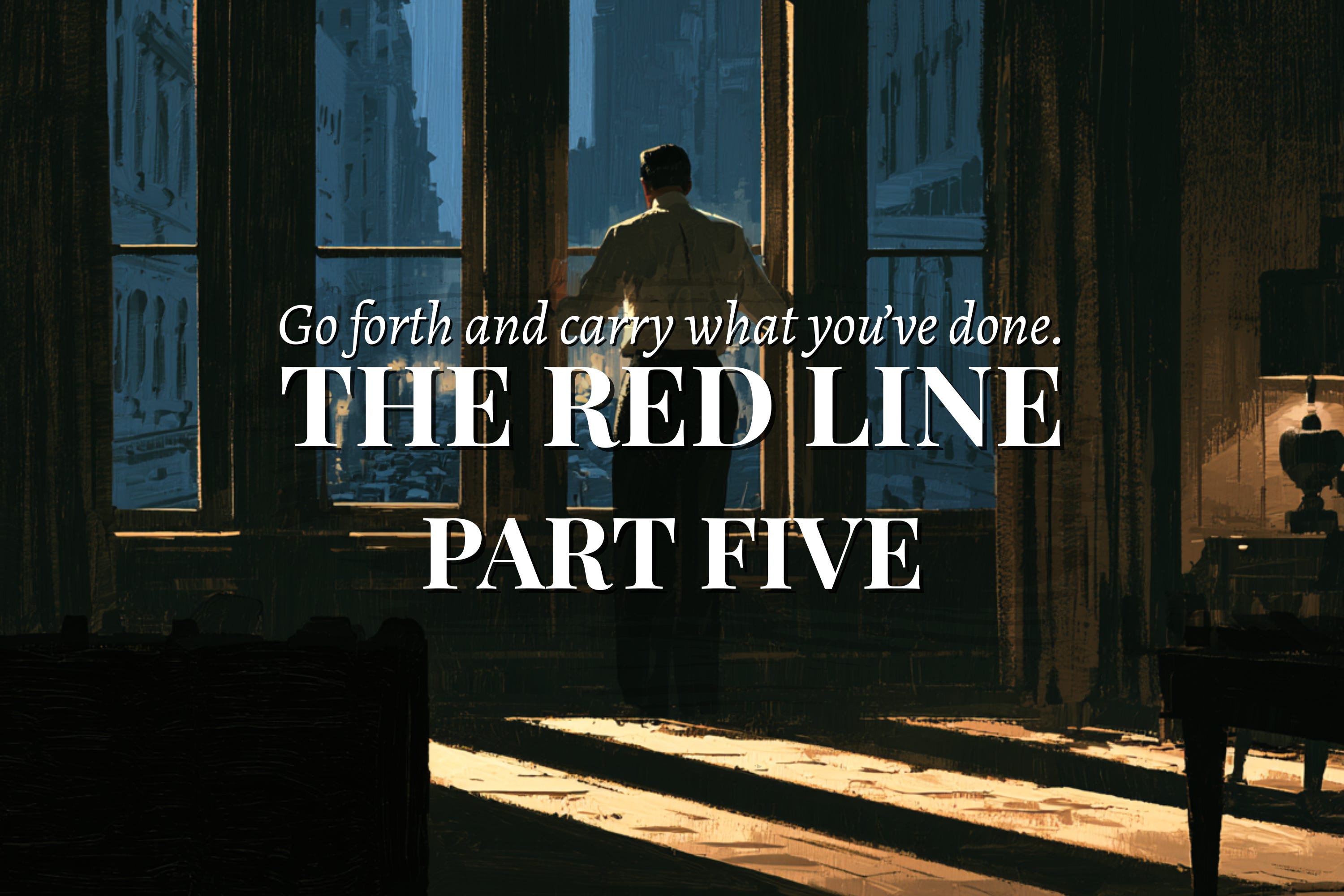
A memory of Clark’s face appeared involuntarily to Callaghan. He closed his eyes, but it only intensified. He shook his head, but it wouldn’t leave him alone. He got to his feet and crossed the floor to the tall windows. He threw aside the white sheers and leaned both arms on the windowsill. Below him, Mercer Boulevard glowed and flickered like it was on fire. The tungsten streetlamps and marquees up and down the road painting the snow a rich, golden yellow. The hollow space in his chest ached like a missing tooth.
“This is how Cain felt,” he said to himself.
Maybe this was Callaghan’s mark. Maybe God didn’t place a visible stain for the world to see, but a secret pain, one he felt to the bottom of his soul, one he would carry forever, like a chronic leg ulcer that would never fully close. Never truly heal.
Callaghan pushed off the windowsill and found the bathroom in the dark. He showered a long time—lathering and rinsing, lathering and rinsing—until the water ran cold and he shut off the taps. He dried himself, dressed in the dark in the hotel’s silk pyjamas, and crawled into bed next to Ivy. She murmured and rolled over, folded into his arms.
“What happened to us, Thomas? How did we get here?”
“Slater Street. Cold water flat. Roaches.”
She lifted her head off his chest.
“But murder? Is that really what it takes?”
Callaghan didn’t respond. He already hated himself for knowing the answer.
Kevin Coleman writes crime fiction from the cold edges of Canada. He suspects God's mercy is not always what it appears to be.
Dr. Callaghan is beginning to count the cost of his ambition,
and secretly worries he can’t afford the interest.
Subscribe to watch it compound.
© 2026 Kevin M. Coleman
Disclaimer
This article is an original work by Kevin M. Coleman. All rights are reserved. No part of this article may be copied, stored, or reproduced in any form — including but not limited to use in training artificial intelligence or machine learning systems — without the author’s express written permission.
This story has me hooked, and I'm following it to the end. Great old-school hard-boiled crime that looks a lot like Hammett in the bast way. I imagine there's a way to weave The Red Line and The Judas Plot novellas together to make a novel-length story. Damn, this is good reading.